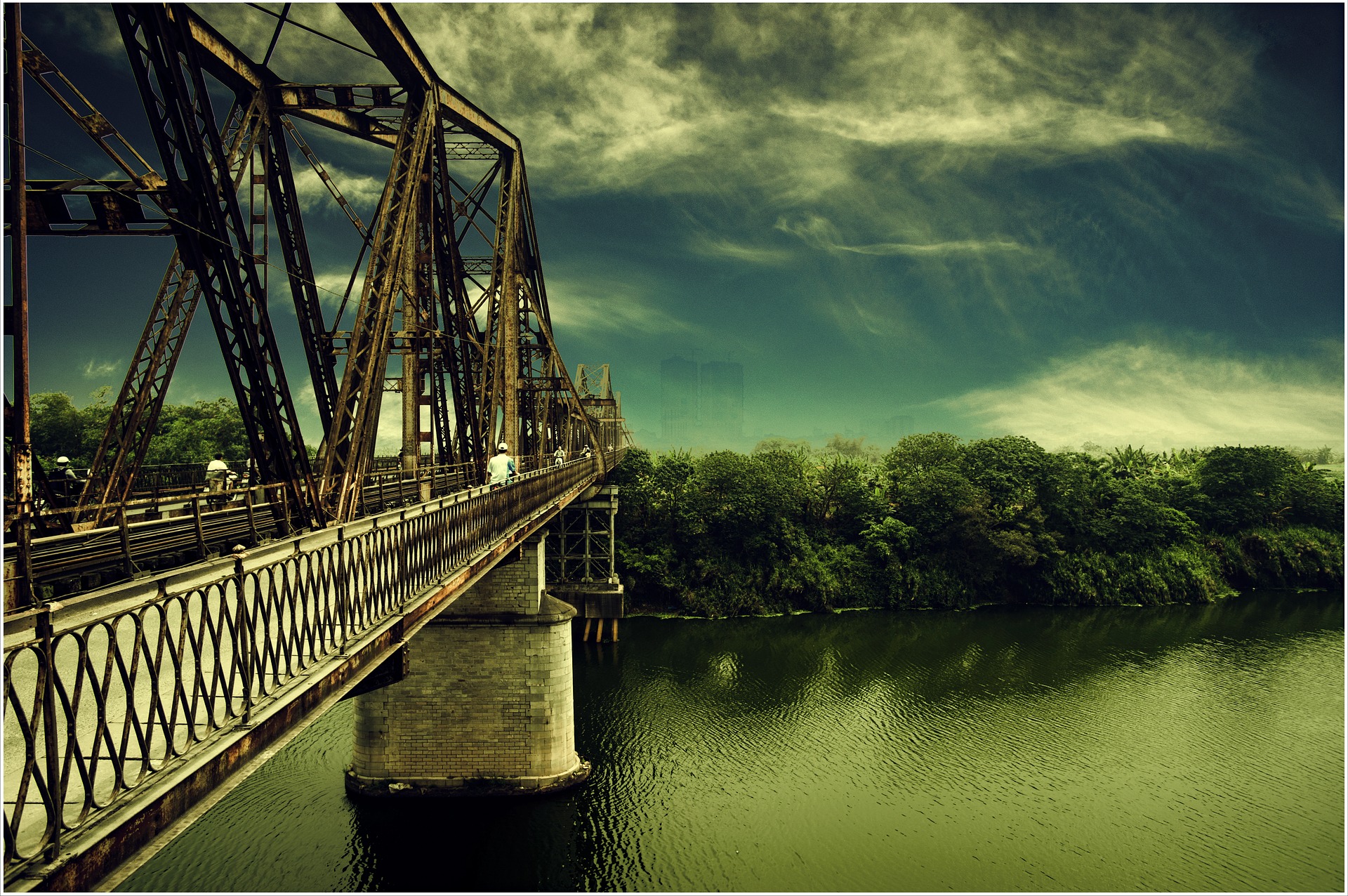
Only a kilometer from the Old Quarter you will find the Long Bien Bridge. The Long Bien Bridge was designed by Gustave Eiffel, who is world-renowned for the Eiffel Tour in Paris. The bridge was built between 1899 and 1902 by architects Daydé & Pillé of Paris, and opened in 1903. More than 3,000 Vietnamese people took part in the construction of this bridge. The bridge was inaugurated on February 2nd , 1902 in the presence of Doumer himself, his successor Paul Beau and the young King Thành Thái. The first train crossed the bridge on February 28th , 1902. At first the Long Bien bridge was built solely for use of a single-track railway line that was bordered by pedestrian walkways. People wishing to cross the Red River by motor vehicle or rickshaw had to take a ferry. This has prompted some historians to believe that the bridge, like many other French colonial structures, was constructed for its symbolic value more than for use as a key transport hub.
The bridge’s links with revolutionary history began in the period immediately after the First Indochina War, when the French used the Hà Nội-Hải Phòng line to evacuate their civilians and troops. It was across the Doumer Bridge that the final contingent of French soldiers walked on the afternoon of October 9th, 1954, after withdrawing from the Hanoi Citadel. The Việt Minh then took possession of the bridge, officially renaming it Cầu Long Biên, or Long Bien Bridge. On the morning of October 10th, 1954, Việt Minh troops entered the city, declaring the capital liberated.
Before North Vietnam’s independence in 1954, it was named the Paul-Doumer Bridge. Doumer was the Governor-General of French Indochina and later the French president. It is 2.4 kilometers long, and at that time was one of Asia’s longest bridges. For the French colonial government, the construction was of strategic importance in securing control of northern Vietnam.
Due to its critical position it was heavily bombarded during Vietnam-American War. It was the only bridge at that time crossing the Red River and connecting Hanoi to the main port of Haiphong. The first attack took place in 1967 and the central part of the bridge was damaged by an attack of 20 USAF F-105 fighter-bombers. However the CIA reports showed that the severing of the bridge did not appear to have caused as much disruption as had been expected. The defense of Long Bien Bridge continues to play a large role in Hanoi’s self-image and is often shown in poetry and songs. The bridge was unusable for a year after May 1972, when it fell victim to one of the first coordinated attacks using laser-guided “smart bombs”. During reconstruction period, an extraordinary floating bridge known as SH1 (Sông Hồng 1) was installed to maintain rail transport between Hà Nội and Gia Lâm. Barges were used to move the pontoons into place at night and then float them away again before first light. Nixon’s “Operation Linebacker” during May through October 1972, inflicted further damage on the Long Biên Bridge by hitting it on four occasions, demolishing three more spans and once again stopping the vital rail link between the capital and the north. As before, a pontoon bridge system, known as SH2, was quickly installed across the Red River to reconnect Hà Nội with Gia Lâm. Ironically, the bridge is remembered today as an icon of defiance against the Americans during the second Indochina War, not as a symbol of colonial power and prestige.

Some parts of the original bridge remain, while large sections have been built later to repair the damage. Only half of the bridge retains its original shape. A project with support and loans from the French government is currently in progress to restore the bridge to its original appearance.
The bridge is a standing symbol of the never ending willpower and resilience of the people of Hanoi. It was bombed several times during the American War. Each time it was quickly repaired by the Vietnamese people. Today the bridge is used by trains, mopeds, merchants and pedestrians. Now it is undergoing reconstruction to restore its original appearance. At night this is a nicely lit up place with a picturesque view. Today, trains, mopeds, bicycles and pedestrians use the bridge, while all other traffic is diverted to the nearby Chương Dương Bridge and some newly built bridges which include the Thanh Trì Bridge, Thăng Long Bridge, Vĩnh Tuy Bridge, and Nhật Tân Bridge. Under the bridge, poor families live in boats on the Red River, coming from many rural areas of Vietnam.
Do you want to see another side of the world of Hanoi? Midway across the Red River, I see Vietnamese guys swimming in the freshwater of Red river naked. With smiles on their faces, these male nudists dip into the cool river for the renowned health benefits. No matter which season it is, hot or cold, they come every day. I’ve seen news reports showing doctors, lawyers, businessmen and simple merchants bathing together.
Many couples make Long Bien Bridge a nice background for their wedding photos. Many tourists come here to visit a historical landmark and view the beautiful scenery. Many youth take nice photos to keep memories of their time on the bridge or in the middle part which is full of green trees. Many vendors and shoppers still come here every afternoon for the small open air market.
At nightfall, vendors on the bridge sell fried corn and sweet potatoes, which appeals to lots of people, especially in the winter. To many locals, it’s a wonderful time to hear the sound of the wind, feel the cool fresh air at sunset and observe the daily lifestyle of others. I like to enjoy private time in a nearby cafe. For example, from the 4th floor of Tran Nhat Duat cafe, I take in the sights of the rocky field in the middle of the Red River, the famous Long Bien Market, and some fantastic scenery of Hanoi. I really feel at peace after watching a beautiful sunset over the city from the Long Bien Bridge.
More informations on:
https://en.wikipedia.org/wiki/Long_Bi%C3%AAn_Bridge
https://www.lonelyplanet.com/vietnam/hanoi/attractions/long-bien-bridge/a/poi-sig/1527197/357880
https://www.vietnamonline.com/attraction/long-bien-bridge.html
https://azlocaltrip.com/long-bien-bridge/